


A comprehensive guide for foreign companies on local hiring in Bangladesh
Introduction: Hiring in Bangladesh Without a Legal Entity
Conducting the local hiring in Bangladesh can put foreign companies in a tight position, especially when they have no local entity. In this condition, utilizing an employer of record (EOR) provides an effective and structured approach, allowing businesses to hire employees while ensuring compliance with Bangladeshi labor laws and regulations. EOR eliminates the need for a complex entity setup and enables foreign companies to efficiently manage payroll and related legal matters. With local expertise, EORs facilitate a smooth onboarding process, allowing businesses to focus on their core operations instead of administrative burdens.
What is an Employer of Record (EOR)?
An Employer of Record (EOR) is a strategic HR partner that serves as the legal employer for your workforce in a specific country—in this case, Bangladesh. While the EOR handles all legal, fiscal, and administrative responsibilities, the employees work daily under your direct management.
How It Works
-
Legal Ownership: The EOR assumes all legal liabilities and local compliance risks.
-
Operational Control: You maintain 100% control over the employee’s tasks, performance, and daily workflow.
-
The Relationship: The employee enjoys a seamless experience, receiving their salary and benefits locally through the EOR while contributing directly to your global goals.
Key Responsibilities of an EOR
-
Local Contract Compliance: Drafting contracts strictly adhering to the Bangladesh Labour Act 2006.
-
End-to-End Payroll: Handling salary disbursement in BDT, including the management of Festival Bonuses (a mandatory local requirement).
-
Tax & Statutory Fund Management: Managing income tax deductions and contributions to the Provident Fund (PF) or Gratuity where applicable.
-
Work Permits (B-Visa): Streamlining the complex process of obtaining work permits for expatriates through BIDA/BEZA.
Why Bangladesh is a Strategic Hiring Destination for Foreign Companies
Bangladesh is quickly becoming a top choice for foreign companies looking to expand their global workforce. The country offers a unique combination of a large, skilled, and cheap talent pool. For businesses aiming to enter new markets, Bangladesh offers a valuable opportunity to hire top talent within the lost cost compared to other regions.
From IT professionals to customer support agents, the country has a growing number of skilled workers ready to contribute to your success.
Let’s look at a few reasons why Bangladesh is a smart move for your business expansion.
Cost advantage over popular outsourcing regions
One of the biggest draws for hiring in Bangladesh is the significant cost efficiency it offers. Compared to other popular outsourcing destinations like India, Philippines, or countries in Eastern Europe, the operational and salary costs in Bangladesh are often much lower. This allows us to scale team and expand operations without breaking the budget.
Instead of facing the high costs and long timelines of setting up a local entity, through EOR, client companies can avoid expenses related to:
- Company registration fees
- Legal consultations
- Opening local bank accounts
This streamlined approach to payroll management and hiring saves you money and time.
Talent availability (IT, BPO, digital marketing, support roles)
Bangladesh boasts a large and growing pool of skilled professionals across various industries. This makes it an ideal location for finding top talent to support your business needs. Whether you are looking for IT talent, Bpo Company professionals, or digital marketing experts, you can find qualified candidates ready to join your team.
The country’s workforce is particularly strong in several key areas. You can easily build a team with expertise in:
- Information Technology (IT) and software development
- Business Process Outsourcing (BPO) and customer support
- Digital marketing and content creation
Partnering with a top Employer of Record provider in Bangladesh, like Enroute International Limited, can simplify the hiring process as they can streamline the process to help clients connect with the best global talent available.
Remote workforce growth in Bangladesh
Yes, Bangladesh is an excellent country for remote hiring and outsourcing. The remote workforce in Bangladesh has seen significant growth in recent years, driven by improved internet infrastructure and a population connected digitally 24/7.
The rise of remote work offers incredible flexibility for global expansion. Companies can tap into a wider talent pool without the constraints of a physical office. This model is supported by a workforce that is adaptable and proficient with digital collaboration tools. Key factors contributing to this growth include:
- Increasing internet penetration across the country
- A young, tech-literate population
- Government support for the digital economy
From ensuring compliant contracts to handling payroll, an EOR provides the structure needed to support your remote workforce and scale your operations smoothly.
Government digitalization & business-friendly policies
In Bangladesh, digitalization has been promoted actively by the government, which has made it easy to adopt and implement business-friendly policies to attract foreign investment. Initiatives under the government vision related to digitalization have improved infrastructure and streamlined many bureaucratic processes, which later made it easier for international companies to operate in the country.
These government policies create a more favorable environment for businesses. The legal requirements for foreign companies hiring through an Employer of Record are straightforward because the EOR handles compliance with local laws. This supportive ecosystem includes:
- Simplified business registration processes
- Incentives for technology and export-oriented sectors
- Efforts to create a more transparent regulatory framework
An EOR partner ensures that you remain fully compliant with all evolving regulations, allowing you to take advantage of the opportunities the market offers without getting bogged down by legal complexities.
How Employer of Record Services Work in Bangladesh
In Bangladesh EOR service is a straightforward process that helps to set up business legally and get the regulatory process done quickly. Once you identify the talent you want to hire, the EOR steps in to act as the legal employer. They handle all the administrative and legal aspects of employment, from drafting contracts to managing payroll.
1) Candidate selection
The first step in using an Employer of Record in Bangladesh is selecting your ideal candidates.
Once you have made your selection, you simply inform your EOR provider. The process for a foreign company to start is easy: you provide the details of your chosen candidate, including their role, salary, and start date. The EOR then takes over the administrative side of the hiring process.
2) EOR onboarding
After you’ve selected your candidate, the EOR begins the onboarding process. This is where the EOR’s HR administration expertise really shines. They collect all necessary documentation from your new hires, such as personal information, tax details, and bank account information for payroll.
Typically, it is a significant advantage for a foreign company that a new employee can be fully onboarded and ready to work in just a few days, sometimes as quickly as 3 to 5 business days.
The EOR handles all the paperwork and initial HR tasks, making sure your employees feel welcomed and supported from day one.
3) Contract issuance
A critical part of the onboarding process is issuing a legally compliant employment contract.
Foreign nationals, for example, those who are employed in INGOs working in Bangladesh, must have a work permit from the Bangladesh Investment Development Authority (BIDA). The law mandates that foreign nationals must apply for a work permit within 15 days of arriving in Bangladesh.
An EOR provider will draft employment contracts that adhere to all aspects of Bangladesh’s employment law.
Getting legal paperwork done faster and more smoothly is one of the key legal requirements for foreign companies hiring in Bangladesh, and using an EOR ensures it’s done correctly.
Also, through contracts, necessary terms like job responsibilities, salary, working hours, leave policies, and termination conditions, etc will be mentioned. It is EOR’s responsibility to ensure every clause aligns with local labor regulations, minimizing any potential legal risks.
4) Payroll & compliance
Yes, an Employer of Record can, and does, handle all aspects of payroll and compliance for foreign companies operating in Bangladesh. They manage the entire payroll processing cycle, ensuring your employees are paid accurately and on time, every time.
The EOR also takes responsibility for tax compliance and other statutory deductions. This means they will calculate, withhold, and remit all necessary taxes and social contributions to the appropriate government authorities. This meticulous approach to payroll compliance removes a significant administrative burden from your team. Key services include:
- Accurate salary calculations and disbursements
- Management of income tax withholdings
- Handling of mandatory social security contributions
5) Roles of client vs EOR provider
Understanding the distinct roles of the client and the EOR provider is key to a successful partnership.
For example, the client company’s primary role is to manage employees’ day-to-day work, set their tasks and goals, and oversee their performance. Thus, the company remains in control of the operational side of its business.
The EOR provider, on the other hand, takes on the administrative burden of employment. Their responsibilities focus on HR administration and legal compliance. To be precise, EOR handles:
- All legal and HR-related paperwork
- Payroll and tax management
- Benefits administration and compliance
EOR provider like Enroute International Limited will clearly define these roles and responsibilities, ensuring a smooth and efficient partnership.
6) Timeline (days vs months compared to entity setup)
One of the most compelling benefits of using an EOR is the drastically reduced hiring timeline.
Normally, with an EOR provider, hiring and getting the employee ready for work in a foreign land takes a week. When the same process might take more than a week, in many cases, a month.
Establishing a legal entity in a new country can take several months, and sometimes even longer. This process involves numerous steps, including:
- Navigating bureaucratic procedures
- Registering with multiple government agencies
- Setting up local bank accounts
The EOR model bypasses all of this with the existing legal infrastructure. Any foreign company can accelerate expansion plans and seize market opportunities in Bangladesh without the long delays associated with entity setup.
Legal & Compliance Framework for Hiring in Bangladesh
Bangladesh has its own specific labor law and local regulations that all employers must follow; foreign employees are no exception in this case. Failure to comply can lead to significant compliance risks, including fines and legal disputes. An Employer of Record specializes in managing these complexities for you.
Let’s explore the key legal areas your EOR will manage.
1) Overview of Bangladesh Labor Law
The Bangladesh Labour Act 2006 is the comprehensive labor law that outlines the rules for employment relationships, working conditions, and employee rights in Bangladesh. Understanding and adhering to this act is essential for any company operating in this country.
The legal requirements for foreign companies hiring through an EOR are met by the EOR, who ensures full compliance with all provisions of the Bangladeshi labor laws. Key areas covered by the act include:
- Working hours and overtime pay
- Leave entitlements, such as annual, sick, and maternity leave
- Health and safety standards in the workplace
An EOR stays up-to-date with any amendments to the employment law, ensuring your company always remains compliant.
2) Employment contract requirements
Under the Bangladesh Labour Act, specific requirements must be met when drafting employment contracts. Every employee must be provided with a formal appointment letter and an identity card.
An EOR ensures the contracts they issue will include all mandatory information, such as the employee’s job title, salary, probation period, and other terms and conditions of employment. This attention to detail is vital for avoiding future disputes.
3) Employee rights & protections
The Bangladesh Labour Act provides employees with a range of rights and protections that employers must respect. These rights are designed to ensure fair treatment and a safe working environment.
Employees in Bangladesh are entitled to several statutory benefits. These employee benefits are non-negotiable and must be provided as part of any compliant employment arrangement. Some of the key protections include:
- Minimum wage standards
- Limits on daily and weekly working hours
- Paid leave, including annual, casual, and sick leave
Your EOR partner will manage the administration of these employee rights and benefits, ensuring full compliance with the Labour Act.
4) Termination policies and compliance risks
Termination of employment in Bangladesh is strictly regulated by the Labour Act. Employers must follow specific procedures, including providing a proper notice period and, in many cases, severance pay. Failing to adhere to these termination policies can lead to significant compliance risks, such as wrongful termination claims and financial penalties.
When choosing an EOR, a potential pitfall is working with a provider that doesn’t have deep expertise in local termination laws. Enroute International Limited can guide you through the process, ensuring every step is handled correctly and minimizing the risks associated with ending an employment relationship.
Payroll, Taxation, and Statutory Obligations in Bangladesh
Managing payroll, taxes, and statutory obligations in a foreign land is a complex task for any organization. Every country has its own tax structure and a set of mandatory benefits that employers must provide. Understanding those terms and adhering to them properly is absolutely tough for any outsider. EOR comes to the rescue in this situation. This service not only helps foreign employers to hire skilled employees but also takes the responsibility for payroll processing and tax compliance.
1) Income tax structure for employees
Bangladesh has a progressive income tax structure, meaning the tax rate increases as an employee’s income rises. The specific tax slabs and rates are determined by the National Board of Revenue (NBR) and can change with the annual budget. All employers are responsible for withholding the correct amount of income tax from their employees’ salaries each month.
Managing these calculations and ensuring timely tax filings can be a complex part of payroll management. An EOR handles this entire process for the client company. They stay current with the latest tax regulations and ensure that the correct deductions are made and remitted to the NBR on behalf of the client’s employees.
2) Payroll processing complexities
Payroll processing in Bangladesh involves more than just calculating salaries. It includes managing variable components like bonuses and allowances, calculating overtime pay correctly, and ensuring all deductions for taxes and other contributions are accurate. These complexities can be challenging for foreign companies to manage from afar.
An EOR is an expert in handling these intricacies. They use specialized systems for payroll processing that are designed to ensure accuracy and legal compliance.
By outsourcing this function, you eliminate the risk of errors that could lead to employee dissatisfaction or legal penalties.
3) Statutory benefits and allowances
Employees in Bangladesh are entitled to a range of statutory benefits as mandated by the Labour Act.
Some of the key statutory benefits in Bangladesh include various types of paid leave:
- Annual leave with pay
- Paid sick leave
- Maternity leave for female employees
These benefits are a fundamental part of the employment package and must be provided by all employers. An EOR ensures that your employees receive all the benefits they are legally entitled to. Additionally, they will track leave balances, ensure compliance with maternity leave regulations, and handle any other legally required allowances.
4) How EOR ensures tax compliance
An EOR provider ensures tax compliance through a combination of local expertise, robust processes, and specialized technology. They have a deep understanding of Bangladesh’s tax laws and stay constantly updated on
This comprehensive service includes:
- Accurately calculating the income tax to be withheld from each employee’s salary.
- Remitting the withheld taxes to the NBR on time.
- Filing all necessary tax reports and documentation with the authorities.
By managing these critical tasks, the EOR shields your business from the risks of non-compliance, such as fines and penalties.
Key Services Included in EOR Services in Bangladesh
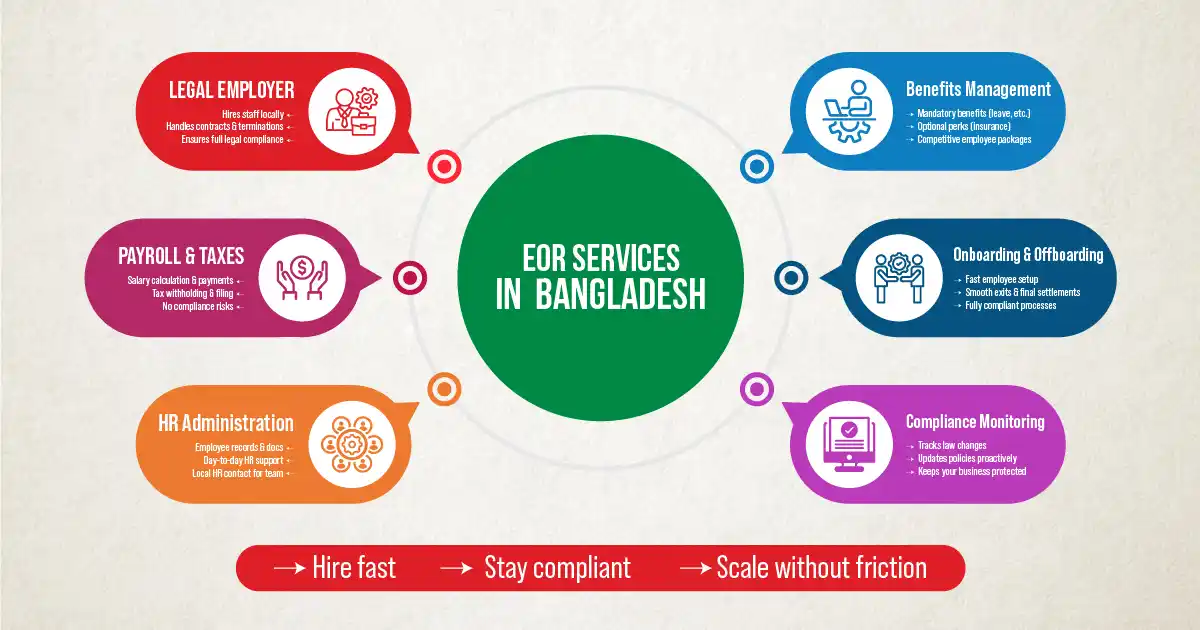
1. Legal employment management
Services included:
- Drafting locally compliant employment contracts
- Acting as the legal employer on paper
- Employee classification (full-time vs contractor)
- Handling work permits (if needed)
- Managing terminations and severance legally
- Ensuring compliance with the Bangladesh Labor Law
2. Payroll & tax handling
Services included:
- Salary calculation (gross → net)
- Payslip generation
- Salary disbursement in local currency (BDT)
- Income tax withholding and filing
- Social contributions (if applicable)
- Expense reimbursements
- Year-end tax reporting
3. HR administration
Services included:
- Employee onboarding documentation
- Maintaining employee records
- Attendance and leave tracking
- HR policy implementation
- Handling employee queries (HR helpdesk)
- Contract updates and amendments
4. Benefits management
Services included:
- Managing statutory leave (annual, sick, maternity)
- Leave accrual tracking
- Administering bonuses (festival bonuses, etc.)
- Setting up private health insurance
- Managing additional perks (allowances, stipends)
- Ensuring compliance with benefit laws
5. Onboarding & offboarding
Services included:
- Employment contract signing
- Document collection (ID, tax info, etc.)
- Payroll system setup
- Employee orientation support
- Notice period management
- Final settlement calculation
- Severance processing
- Exit documentation
- Compliance with termination laws
6. Compliance monitoring
Services included:
- Monitoring changes in labor laws
- Updating contracts and policies accordingly
- Ensuring tax regulation compliance
- Conducting internal compliance checks
- Risk assessment and reporting
- Advising on legal changes impacting employment
Benefits of Using Employer of Record Services in Bangladesh
EOR removes the biggest obstacles that may come along with hiring internationally. This allows you to build your team without the need to establish a local legal entity.
This streamlined model for global workforce management provides advantages in speed, cost, and risk reduction. Let’s explore the key benefits in more detail.
1) No need for local entity setup
The traditional process of entity setup is notoriously slow, expensive, and complicated. It involves navigating a maze of legal and bureaucratic requirements that can take months to complete.
Using an EOR allows you to bypass this entire process. The EOR already has an established legal entity in Bangladesh, which they use to employ staff on your behalf. This means you can start hiring and operating in the market almost immediately.
2) Faster hiring (weeks vs months)
Time is a critical resource in business, and the speed of an EOR-driven hiring process provides a major competitive advantage. As we’ve noted, hiring with an EOR typically takes just a matter of days or weeks, not months. This allows you to onboard talent and begin operations with incredible speed.
- EOR: Onboarding in 3-10 business days
- Entity Setup: Process can take 3-6 months or more
3) Reduced legal risk
Expanding into a new country inherently comes with legal risks, especially when dealing with unfamiliar labor laws. An EOR significantly reduces these compliance risks by taking on the responsibility of the legal employer. They are experts in local regulations and ensure that all employment practices are fully compliant.
4) Cost efficiency
Using an EOR is a highly cost-efficient way to expand your team globally. The most obvious saving comes from avoiding the high upfront costs of setting up a legal entity, which can include legal fees, registration costs, and capital requirements.
The cost of using an EOR is typically a transparent, fixed fee per employee per month. This predictable pricing model makes budgeting for your international expansion much simpler. It covers all the essential services, including:
- Payroll management
- Tax compliance
- Benefits administration
5) Scalability & flexibility
EOR services offer scalability and flexibility for your global workforce management. Whether you’re hiring one employee or building a team of fifty, the EOR model can adapt to your unique needs.
This flexibility is particularly valuable for companies testing a new market or working on specific projects.
You can hire employees for a fixed term without the long-term commitment of establishing a permanent entity.
The EOR model is also ideal for managing a remote workforce. It provides the necessary legal and administrative structure to support employees across different locations within Bangladesh.
Risks of Hiring Without an EOR in Bangladesh
While the idea of hiring directly in Bangladesh might seem straightforward, it comes with a number of significant risks. Without the support of an EOR, your company is directly exposed to all the legal and financial liabilities of being an employer in a foreign country. These compliance risks can be costly and damaging.
Below are some of the key risks you could face –
1) Legal penalties and compliance issues
Hiring in Bangladesh without a proper legal structure exposes your company to severe legal penalties and compliance issues. Non-compliance can result in heavy fines, back-payment orders, and even legal action.
These compliance risks can arise from various areas of employment. Common mistakes that lead to penalties include:
- Failing to provide statutory benefits
- Violating rules on working hours or overtime
- Improperly handling employee terminations
2) Misclassification risks (employee vs contractor)
A common mistake foreign companies make is hiring individuals as independent contractors when they should legally be classified as employees. This misclassification risk is a serious issue in many countries, including Bangladesh. The distinction between contractors and employees is based on specific legal criteria, not just the title you give someone.
If authorities determine that your contractors are actually “disguised employees,” your company can face severe penalties. These can include back payment of taxes, social security contributions, and employee benefits, along with significant fines. This is one of the biggest pitfalls to watch out for in your employment practices.
3) Payroll and tax errors
Managing payroll and taxes in a foreign country is fraught with potential for error. Without expert knowledge of local regulations, it’s easy to make mistakes in calculating deductions, withholding the correct amount of tax, or making timely tax filings. These errors can lead to serious payroll compliance issues.
The consequences of such mistakes can be severe. You could face penalties from the tax authorities, audits, and legal claims from employees who have been paid incorrectly. The lack of proper compliance monitoring can quickly turn a small error into a major financial liability.
4) Contract disputes
Without a deep understanding of Bangladesh’s employment law, you run the risk of creating employment contracts that are not legally compliant. A poorly drafted contract can be a source of future contract disputes, leading to legal challenges from employees. These disputes can be time-consuming and expensive to resolve.
5) Operational inefficiencies
Trying to manage international employment in-house creates significant operational inefficiencies. Your team will spend valuable time and resources trying to navigate unfamiliar administrative processes, from payroll processing to benefits management. This administrative burden distracts them from their core responsibilities and slows down your business.
These inefficiencies can have a real impact on your bottom line. Time spent on administrative tasks is time not spent on revenue-generating activities. Moreover, the risk of making mistakes is high, which can lead to further delays and costs as you work to correct them.
Cost of Employer of Record Services in Bangladesh
Understanding the cost structure associated with EOR services in Bangladesh is essential for foreign companies considering entry into this market. Typically, pricing models can vary, with some EOR providers charging a per-employee fee while others may take a percentage of each employee’s salary. Comparing these costs against the expenses of establishing a local entity shows tangible savings. Companies should also be mindful of hidden fees such as compliance and payroll administration costs, ensuring they grasp the total financial commitment to leverage potential benefits effectively.
1) Per employee fee
Costs for EOR services typically involve a per-employee fee, which provides a straightforward pricing structure. This fee encompasses essential services such as payroll processing, benefits administration, and compliance management. Companies benefit from predictable monthly expenses, allowing for effective budgeting and financial planning. While the per-employee fee can vary based on the level of service and local labor laws, it ensures that foreign companies avoid the complexities of establishing a local entity. Ultimately, it streamlines the hiring process while minimizing administrative burdens associated with legal compliance.
2) Percentage of salary
An employer of record typically charges a percentage of the employee’s salary as a fee for its services. This fee structure provides an attractive option for foreign companies seeking to enter the Bangladeshi market without the administrative burden of establishing a local entity. By leveraging eor services, businesses can navigate local labor laws and compliance risks more efficiently. Such a model also allows for flexible budgeting, as the fee scales with the workforce’s salary, ensuring cost-effective management while providing peace of mind regarding legal compliance.
3) Cost comparison vs setting up a company
Establishing a local entity can require significant financial investment, including incorporation fees, legal costs, and ongoing operational expenses. In contrast, leveraging Employer of Record services often presents a more cost-effective alternative. With an EOR, foreign companies avoid the administrative burden of compliance with Bangladeshi labor laws and regulations, paying only a straightforward fee for employment-related services. This streamlined approach also minimizes hidden costs associated with setting up a company, such as payroll processing and tax filings, allowing businesses to focus on growth without the complexities of local compliance.
Industry Use Cases: Who Should Use EOR Services in Bangladesh
Various industries can benefit significantly from employer of record services in Bangladesh. Technology firms seeking to tap into the local talent pool, especially in software development and IT services, often utilize EOR to streamline hiring and compliance. Additionally, businesses in the BPO sector leverage these services to manage their workforce more effectively while ensuring adherence to local labor laws. Manufacturing companies expanding operations or launching new projects in Bangladesh also find EOR solutions valuable for handling payroll and employment contracts, minimizing administrative burdens, and legal risks associated with direct hiring.
How to Choose the Right EOR Provider in Bangladesh
Selecting an Employer of Record (EOR) provider in Bangladesh involves evaluating several key factors.
- Begin by assessing the provider’s expertise in local labor laws and tax compliance to mitigate legal risks.
- Consider their ability to handle payroll processing and benefits administration effectively.
- An ideal EOR partner will also offer scalable solutions for your global workforce management needs.
- Look into their reputation, service flexibility, and responsiveness to ensure they align with your unique hiring practices.
This thoughtful approach will enhance your experience in managing new hires seamlessly.
Why Choose Enroute as Your Employer of Record Partner
Expanding into a new territory requires more than just a service provider; it requires a strategic partner who understands the pulse of the local landscape. Enroute International Limited combines 17+ years of HR excellence with deep regulatory expertise to offer the most secure EOR framework in Bangladesh.
The Enroute Strategic Advantage
-
17+ Years of Proven Expertise: Since our inception, we have navigated the evolution of the Bangladesh Labour Act 2006. Our “Experience” isn’t just a number; it is a history of managing thousands of employees for global INGOs, Fortune 500 consultancies, and tech startups.
-
INGO & Consultancy Specialization: We are not a “generalist” provider. We understand the specific nuances of grant-funded projects, tax-exempt structures for INGOs, and the high-compliance needs of international consulting firms.
-
100% Audit-Ready Compliance: Our dedicated compliance team serves as your local liaison with the Bangladesh Investment Development Authority (BIDA) and the National Board of Revenue (NBR). We ensure every Taka is accounted for and every tax filing is submitted on time.
-
Zero-Risk Expansion: By assuming the role of the legal employer, Enroute takes on the full burden of legal liability. We manage labor disputes, termination complexities, and statutory obligations so your global reputation remains protected.
-
Transparent & Fixed Pricing: We believe in “No Hidden Costs.” Our pricing model is transparent, providing a clear breakdown of statutory benefits (Festival Bonuses, Gratuity, PF) versus our service fee. This allows you to forecast your expansion costs with 100% accuracy.
When you choose Enroute, you aren’t just hiring a payroll company; you are gaining a foothold in Bangladesh. We provide the networks, resources, and legal infrastructure necessary to transform a complex international expansion into a seamless operational success.
Ready to build your team in Bangladesh? Contact our Expert Consultants Today
Conclusion
Entering the Bangladeshi market is a high-reward opportunity, but the complexities of local labor laws and administrative red tape shouldn’t be the barrier to your success. Choosing an Employer of Record (EOR) is more than just an outsourcing shortcut—it is a strategic decision to prioritize speed, compliance, and risk mitigation.
By partnering with an established EOR like Enroute, you bypass the 6-month delay of entity setup and the legal minefield of unfamiliar tax regulations. Instead, you gain the agility to onboard top-tier talent in days, ensuring your operations are 100% compliant with the Bangladesh Labour Act from day one.
In a rapidly growing economy, the winner is often the one who can deploy resources the fastest. With the operational and legal burden off your shoulders, you are free to focus on what truly matters: growing your business and achieving your strategic goals in Bangladesh.
Frequently Asked Questions
1. What is an Employer of Record (EOR) in Bangladesh?
An Employer of Record (EOR) in Bangladesh is a legal entity that hires employees on behalf of a foreign company. The EOR assumes all responsibilities for payroll, tax withholding, social security contributions, and compliance with the Bangladesh Labour Act, while the client company maintains day-to-day management of the staff.
2. Is EOR legal in Bangladesh?
Yes. EOR services are fully legal and widely recognized in Bangladesh. It is a compliant structure that allows foreign enterprises to operate without a local “Permanent Establishment” (PE), provided the EOR manages all statutory requirements, including NBR tax filings and BIDA-regulated work permits.
3. Can a foreign company hire in Bangladesh without a local entity?
Absolutely. Foreign companies can legally hire local talent without a registered branch or subsidiary by using an EOR. The EOR acts as the “Employer for Legal Purposes,” while the foreign firm remains the “Employer for Functional Purposes.”
4. How long does it take to onboard an employee via EOR?
At Enroute, onboarding typically takes 3 to 10 business days. This is significantly faster than the 3 to 6 months required to set up a local Private Limited Company and register with the Registrar of Joint Stock Companies and Firms (RJSC).
5. What are the costs of EOR services in Bangladesh?
EOR costs generally consist of two components:
-
Gross Salary & Statutory Benefits: (Base pay, Festival Bonuses, and Provident Fund).
-
Management Fee: Usually a fixed monthly fee per employee or a small percentage of the total payroll. Note: Using an EOR typically reduces expansion costs by up to 60% compared to entity setup.
6. What statutory benefits are mandatory for employees in Bangladesh?
Under the Bangladesh Labour Law, employees are entitled to:
-
Festival Bonuses: Two mandatory bonuses per year (typically 50-100% of basic salary).
-
Leave: Earned leave, Sick leave (14 days), and Casual leave (10 days).
-
Maternity Benefits: 16 weeks of paid leave.
-
WPPF & Gratuity: Specific contributions based on company size and tenure.
7. Is Bangladesh a good destination for remote hiring and outsourcing?
Yes. Bangladesh is currently ranked as a top global destination for IT and BPO services due to a 30-40% cost advantage over regional competitors. With a massive youth population and increasing English proficiency, it is ideal for tech, digital marketing, and back-office operations.
8. Can an EOR sponsor work permits (B-Visa) for expats?
Yes. A qualified EOR in Bangladesh can facilitate the application for Work Permits through the Bangladesh Investment Development Authority (BIDA). This allows foreign firms to station expatriate managers in Dhaka without needing a local trade license.
9. Does using an EOR create a Corporate Tax liability for the foreign parent company?
Generally, no. Using an EOR helps mitigate the risk of “Permanent Establishment” (PE). Since the EOR handles all local corporate and payroll taxes, the foreign company usually avoids being taxed on its global income within Bangladesh. However, we recommend a specific tax consultation for high-revenue operations.
10. EOR vs. Opening a Local Company: Which is better?
Choose an EOR if you want to test the market, hire quickly, or manage a team of 1–50 people without administrative overhead. Choose a Local Entity only if you plan to hold significant local assets, sign local contracts, or require a long-term physical presence exceeding 2–3 years.
Leave a Reply