



Payroll processing in Bangladesh must comply with the Bangladesh Labour Act 2006 (as amended) and Labour Rules, income tax laws and NBR guidance, and, where applicable, WPPF and other statutory obligations. This guide breaks down what it includes, how the monthly process works, and when outsourcing makes sense.
Every business with employees in Bangladesh runs payroll every single month. But most founders and HR managers only learn what payroll processing really involves after something goes wrong, such as a missed tax deadline or an incorrect overtime calculation.
So what is payroll processing?
It is the systematic calculation and disbursement of employee salaries each pay period, covering gross to net salary computation, statutory deductions, allowance calculation, payslip generation, and bank disbursement. In Bangladesh, this process must comply with the Bangladesh Labour Act 2006, National Board of Revenue (NBR) income tax rules, and Workers’ Profit Participation Fund (WPPF) obligations for eligible companies.
This guide is written for small and medium businesses, NGOs, and enterprises operating in Bangladesh. It covers what payroll processing includes, how it works month by month, how it differs from payroll management, key compliance rules, and how to decide whether to handle it in-house or outsource.
This guide provides a general overview of payroll practices and legal frameworks in Bangladesh and is not a substitute for professional legal or tax advice. Laws, rules and tax slabs change frequently; readers should verify critical information against the latest official sources and consult qualified advisors before making decisions.
What Does Payroll Processing Include in Bangladesh?
Payroll processing in Bangladesh includes calculating an employee’s basic salary, allowances, and overtime, subtracting statutory deductions like income tax and provident fund contributions, then generating payslips and transferring the final amount to each employee’s bank account or mobile financial service.
This is often called the gross-to-net calculation. Gross salary is everything an employee earns before deductions; net salary, or take-home pay, is what actually lands in their account.
The core components that must be processed each month include:
- Basic Salary:
In many organizations, basic salary is commonly structured at around 50–60% of gross pay (subject to company policy and sectoral wage regulations). The figure used to calculate overtime, gratuity, and provident fund contributions, house rent and medical allowances, transport allowance, overtime pay, and the festival bonus.
- House Rent Allowance:
House rent allowance is often set as a percentage of basic salary, commonly somewhere in the 10–40% range, depending on company policy and applicable wage regulations.
- Medical and Transport Allowances:
Fixed allowances are intended to offset commuting and healthcare costs.
- Overtime Pay:
For eligible workers, overtime hours must be tracked and compensated at twice the worker’s ordinary rate of wages (as defined in the Bangladesh Labour Act and Labour Rules).
- Festival Bonuses:
In many sectors, employers provide two festival bonuses per year (e.g., aligned with major religious or cultural festivals like Eid-ul-Fitr, Eid-ul-Adha, Durga Puja, or Bangla Noboborsho), in line with the Labour Act, sector‑specific wage orders, and prevailing industrial practice.
- Statutory Deductions (TDS, WPPF & Funds):
From the gross salary amount, statutory deductions are applied, mainly TDS, provident fund contributions, and WPPF where applicable, before the employer generates payslips and disburses salaries.
- Net Salary Disbursal and Documentation:
Finalizing the transaction via secure bank disbursement or approved electronic channels, followed by the mandatory distribution of detailed monthly payslips.
The whole point of payroll processing is accuracy. A single miscalculation in overtime or tax withholding can create compliance problems and damage employee trust.
Payroll Processing Steps: How It Works Month by Month
Most companies in Bangladesh follow a similar monthly cycle to process payroll. Understanding each step helps you spot where errors typically creep in.
This translates to six distinct steps carried out every month:
- Data Collection and Attendance Inputs:
HR gathers all variables for the current month, including daily attendance sheets, leaves taken, late arrivals, overtime hours logged, and performance-based commission inputs. Most payroll errors occur due to late or incomplete entries at this phase.
2. Gross-to-Net Salary Calculation:
This step turns attendance data into actual pay. The system starts with the employee’s basic salary, adds anything extra like bonuses or overtime, then subtracts deductions for unpaid leave or penalties, to arrive at the final salary amount.
3. Statutory Compliance Verification:
The team applies statutory deductions, including income tax withheld at source, provident fund contributions for eligible employees, and WPPF where the company meets the threshold, while confirming wage payment timelines meet legal requirements.
4. Internal Review and Approval:
Finance or management reviews the calculated payroll for accuracy before authorizing disbursement, the last checkpoint to catch errors before money moves.
5. Bank and Wallet Disbursement:
Salaries are transferred to employee bank accounts. The Bangladesh Labour Act 2006 sets specific deadlines (expressed in days from the end of the wage period) within which wages must be paid. Employers should verify the exact time limits in the latest version of the Act and Rules and align their payroll cut‑off accordingly.
6. Payslip Distribution and Statutory Reporting:
The payroll team generates salary sheets, individual payslips, bank transfer files, and tax withholding records to support audits, tax filings, and internal record-keeping.
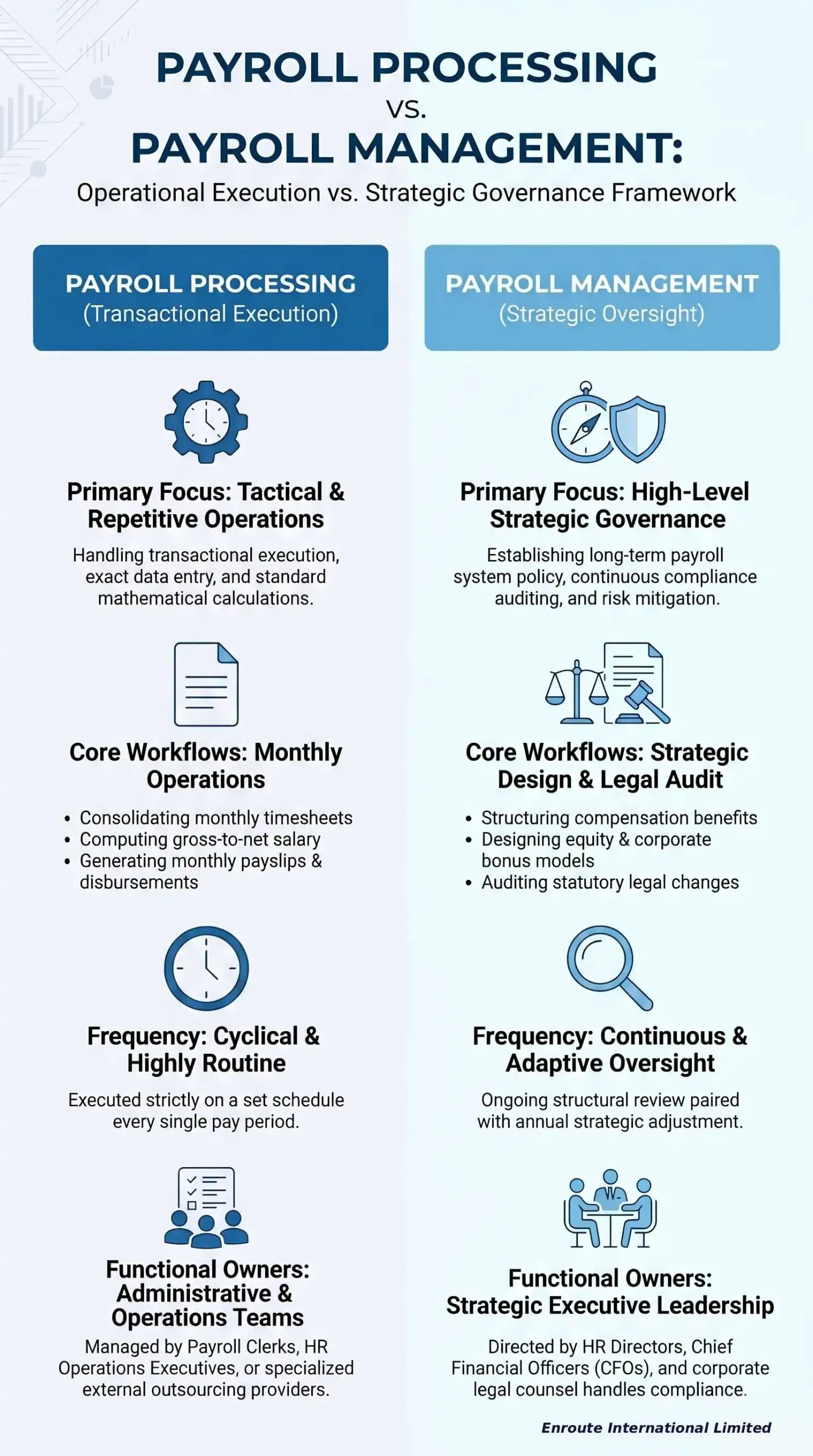
Payroll Processing vs Payroll Management — What Is the Difference?
While these two terms are often used interchangeably by corporate managers, they represent distinctly different operational layers within business operations.
Below is an infographic breakdown clarifying how these two functions operate within an organization:
Payroll Processing Compliance Requirements in Bangladesh
Payroll compliance in Bangladesh is governed by four main areas: the Bangladesh Labour Act 2006, NBR income tax rules, WPPF obligations for eligible companies, and provident fund and gratuity requirements. Getting any of these wrong can lead to penalties and legal risk for employers. So to avoid any kind of violation of labor laws, every business must abide by the following laws or hire payroll service providers who are aware of these laws and their compliance.
Bangladesh Labour Act 2006
Bangladesh Labour Act 2006, amended up to 2018/2022, is the primary legislation for employment conditions, including wages, working hours, and wage payment. As supporting laws, the Bangladesh Labour Rules 2015 operationalize many provisions (e.g., registers, procedures), and employers must comply with both the Act and the Rules.
The Bangladesh Labour Act 2006 (as amended) generally provides for a maximum of 8 hours of work per day and 48 hours per week for adult workers, with prescribed limits and conditions for overtime and extended hours. Specific rules and exceptions may apply by category of worker and sector.
NBR Income Tax and TDS
Under the Income Tax Act 2023 and updated National Board of Revenue (NBR) guidelines, employers are legally required to deduct Tax Deduction at Source (TDS) from employee salaries.
Employers must calculate TDS based on the latest personal income tax slabs and thresholds notified by the National Board of Revenue (NBR) for each assessment year (including any special thresholds for women and senior taxpayers).
Because slabs and thresholds change over time, payroll calculations should always use the most recent Finance Act and NBR circulars.
Employers are required to deposit these withheld tax amounts using the prescribed challans/forms within the statutory deadlines and to provide employees with documentation (e.g., certificates) evidencing tax withheld for each relevant income year.
The following slabs illustrate how progressive personal income tax works for resident individuals in Bangladesh for a specific financial year. These figures are subject to change in each Finance Act and NBR circular, so they must be confirmed against the latest official schedule before using them for payroll or tax calculations.
For example, let’s take data for the FY 2025 to 2026 as a reference to get an idea of the application of personal income tax rates on each individual while calculating payroll –
Personal income tax slabs (resident individuals, FY 2025–26)
| Total annual income (BDT) | Tax rate (%) |
| First 3,50,000 | 0 |
| Next 1,00,000 | 5 |
| Next 400,000 | 10 |
| Next 500,000 | 15 |
| Next 500,000 | 20 |
| Next 2,000,000 | 25 |
| Balance | 30 |
Note: Higher tax‑free thresholds may apply for women, senior citizens (65+), persons with disabilities and certain other categories, as notified by NBR for the relevant assessment year. (source: link)
WPPF (Workers’ Profit Participation Fund)
Under the Bangladesh Labour Act and relevant rules, certain companies that meet specified thresholds (such as minimum paid‑up capital or fixed assets) must constitute a Workers’ Profit Participation Fund (WPPF) and allocate a prescribed percentage of net profit to be distributed among the WPPF, welfare fund and workers’ welfare foundation. The exact thresholds, calculation base and percentage should always be confirmed against the latest legal text and guidance.
Provident Fund and Gratuity
Where an employer maintains a provident fund scheme, contribution rates and eligibility (e.g., after one year of service) are generally defined in the scheme rules, subject to minimum legal and tax recognition requirements. In many schemes, employers and employees contribute a fixed percentage of basic salary, but the exact rate (e.g., 7–8% or otherwise) must be set out in the approved PF rules.
Some employers operate gratuity schemes where the benefit is calculated based on a multiple of the last basic salary for each completed year of service (for example, one month’s basic per year, with higher multiples after a certain length of service). The exact formula, eligibility conditions and interaction with statutory termination benefits should always be aligned with the Bangladesh Labour Act and the employer’s own approved policies.
Common Payroll Processing Challenges for Bangladesh Businesses
The most common payroll processing challenges in Bangladesh are manual calculation errors, keeping up with frequent compliance changes, managing mobile financial service disbursements, coordinating payroll across multiple locations, and meeting strict reporting standards for INGOs and donor-funded organizations.
- Manual Errors: Human-generated calculation errors, tax withholding, or incorrect payouts may be calculated from localized spreadsheets for gross-to-net salary computation regularly.
- Frequent Compliance Updates: Staying aligned with sudden NBR income tax updates, shifting minimum wage structures, or structural changes to the Income Tax Act 2023 requires continuous manual monitoring. For most businesses, keeping a dedicated team for such activity might cost more.
- MFS Disbursement Complexities: Many employees, especially in retail, manufacturing, and field-based roles, are paid through mobile financial services rather than bank accounts, adding another channel to manage accurately.
- Multi-Location Attendance Syncing: Companies operating across several cities often deal with different minimum wage rates and disconnected attendance systems, which leads to struggles in calculation if not recorded under a unified system.
- INGO Donor Fund Tracking: International non-governmental organizations face complex compliance requirements that demand precise allocation of employee hours and salary costs across specific, isolated donor grants.
These challenges compound as a company grows, which is why many businesses eventually reassess whether to keep payroll in-house.
Should You Process Payroll In-House or Outsource?
Deciding whether to build an internal payroll infrastructure or leverage specialized external vendors depends on your company’s growth stage and risk tolerance.
When to Keep Payroll In-House
- Your operation has a small, static team with fixed monthly salaries and minimal structural variations.
- Your internal finance department has the bandwidth and specialized tax expertise to keep up with changing regulatory laws.
When to Outsource Payroll Processing
- Your business is scaling rapidly, leading to high-volume hiring or a complex mix of contract, factory, and full-time personnel.
- Your leadership team wants to mitigate the risk of financial penalties stemming from incorrect TDS filings, BLA 2006 violations, or complex audit failures.
- You want to free up internal HR and accounting teams to focus on strategic business development rather than repetitive monthly administrative data entry.
For expanding businesses, partnering with a professional payroll service provider offers a practical way to balance operational agility with absolute regulatory compliance.
Transform Your Payroll Operations with Enroute
Managing complex salary computations, keeping track of changing tax slabs, and ensuring complete alignment with the Bangladesh Labour Act 2006 can place a heavy administrative burden on your business.
As a reliable payroll processing company in Dhaka, Enroute International Ltd manages end-to-end payroll processing and comprehensive compliance solutions for 200+ organizations across Bangladesh. We lift the burden of administrative tasks off your shoulders by handling precise gross-to-net salary calculations, accurate monthly TDS computations, automated bank disbursements, and detailed regulatory reporting.
Ready to protect your business from compliance risks and secure a seamless, error-free monthly salary cycle for your entire team?
Get a Free Consultation Today or contact our payroll compliance specialists directly at +88 09610405060 to discover how you can confidently outsource payroll processing in Bangladesh.
Frequently Asked Questions
How does payroll processing work in Bangladesh?
It begins by collecting monthly attendance, leave, and overtime records. These variables are calculated against the base salary structure while incorporating statutory deductions like the matched Provident Fund and NBR-mandated salary TDS. Once authorized through internal approvals, funds are distributed via bank transfers (BEFTN) or MFS channels, followed by the issuance of individual payslips.
What is the legal timeline for paying employee salaries under the Bangladesh Labour Act?
According to the Bangladesh Labour Act 2006, an employer must fully pay all salaries and outstanding wages to their employees within 7 days after the end of the wage period . This is a simplified summary; employers should verify exact statutory timelines.
What is TDS in payroll processing?
In payroll, Tax Deducted at Source (TDS) is the income tax that employers must withhold from employee salaries before payment, based on estimated annual taxable income and the current NBR tax slabs. The employer then deposits these withheld amounts to the government within statutory deadlines and gives employees documentation (e.g., certificates) showing how much tax was deducted.
Why do companies outsource payroll processing in Bangladesh?
Organizations outsource payroll processing to reduce manual data errors, eliminate compliance risks with the NBR and Bangladesh Labour Act, ensure timely disbursements across multiple bank accounts or MFS providers, and keep internal teams focused on core revenue-generating business operations.
Leave a Reply